
Training

Training

If you are a CPS employee, please email [email protected].


SIGN UP: 

Due to the passage of Public Act 102-0339, the Illinois State Board of Education requires any educator who has used time-out, isolated time-out, or physical restraint during the past three years to complete 8 hours of training focusing on:

  • crisis de-escalation
  • restorative practices
  • identifying signs of distress during physical restraint and time-out
  • trauma-informed practices; and
  • behavior management practices

The Center for Intensive Behavioral Supports (CIBS) Professional Learning Modules meet the annual training requirements outlined in Public Act 102-0339. Click the image below to download a PDF overview of the available professional learning modules and how they align with the identified annual focus areas. The second page of this document allows for alignment of your emergency safety program and PA 102-0339.
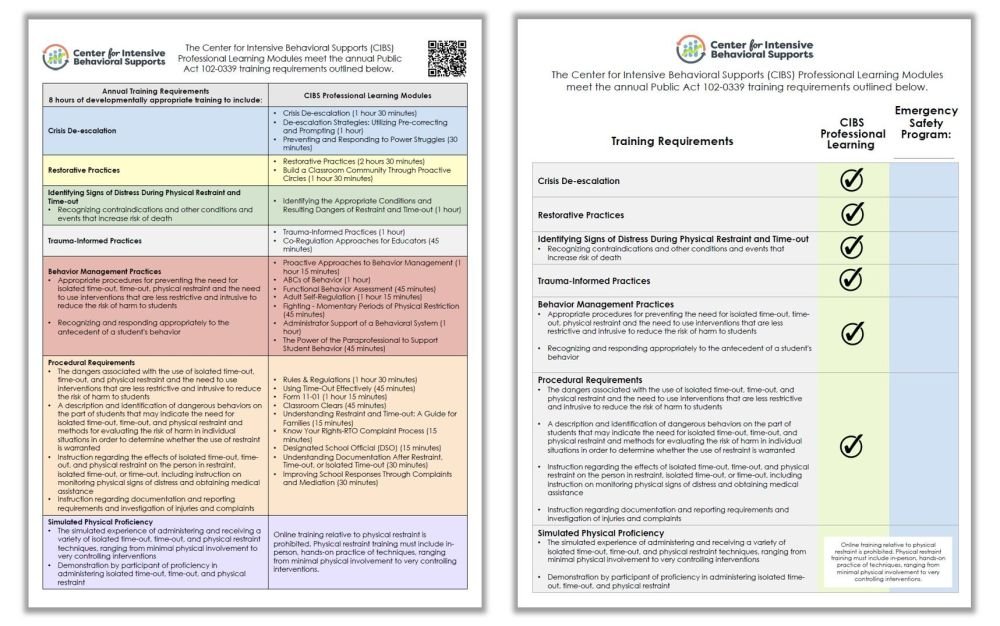
Module Overview image 2

All materials are based on field research and best practices, with implicit bias content integrated throughout each module. To access the learning platform, set up an account and register, and use the Login or Sign Up button below.


After completing a module and the post-training survey, participants may download a Certificate of Completion. Each participant must download and save the certificate for each completed module and share it with school administrators to document training completion. In addition, for those seeking ISBE professional development hours, there is an option for participants to complete the ISBE evaluation and, after successful submission, download the evidence of completion form.

When you create an account, we recommend using your work email address as your username for consistency and easy access.

Login or Sign Up


Once registered and access is granted to the learning platform, all participants must view the Introduction module. Then, participants can enroll in other training based on:

  • identified areas
  • participant interest
  • annual 8-hour training requirements

Below are descriptions of each training:

Intro Website
Review the Introduction to gain an overview of the courses.
Rules and Regs Website

Restraint and Time-out (RTO) Rules and Regulations


This module outlines the newly amended rules and regulations developed by the Illinois State Board of Education and the Illinois State Board of Regulation.
Read More
De-escalation Website

Crisis De-escalation


This module focuses on interrupting an escalating behavior cycle to minimize the need for physical intervention or exclusionary discipline.
Read More
Behavior Support Website 1

Behavior Support Practices


Proactive Approaches to Behavior Management, The ABCs of Understanding Behavior, and Functional Behavior Assessment
Read More
Trauma Website

Trauma-Informed Practices


This module focuses on the lasting impacts a child can experience as a result of exposure to adverse childhood experiences (ACEs) or trauma.
Read More
Restorative Website

Restorative Practices


The module focuses on an alternative to traditional punitive discipline.
Read More
Signs of Distress Website

Identifying the Appropriate Conditions and Resulting Dangers of Restraint and Time-out


This module focuses on defining imminent danger to increase the ability of staff to understand the appropriate use of restraint and time-out (RTO), identify visual and audible signs of distress, and articulate physical and psychological contraindications that limit the use of RTO with specific students.
Read More
Proactive Circles

Build a Classroom Community Through Proactive Circles


This module will examine community circles as a foundational strategy for using the power of relationships to create a positive classroom climate and culture.
Read More
Mid-Valley Logo

Mid-Valley SPED Coop Learning Beyond Boundaries Webinar


In this module, Lisa Palese from Mid-Valley Special Education Cooperative outlines her experience receiving a state complaint from the initial student incident through the resulting evolution in school support for all students.
Read More
001 - Implicit Bias - Introduction Implicit Bias

Implicit Bias


In this module, we look at the influence of implicit bias and the disproportionate discipline practices used by schools, particularly in response to behavior by people of color and those with disabilities.
Read More
Time Out 2

One Tool in the Toolkit: Using Time-Out Effectively


This module reviews the basics of time out, is intended to confirm or deepen your knowledge, and provides information on best practices in using time-out.
Read More
african american hand with pen writing on paper

Form 11-01: Let’s Get Accurate Data!


The Physical Restraint and Time-out Form, often referred to as Form 11-01, is required to report the information to ISBE. This module was designed to help staff complete the ISBE Form 11-01 correctly.
Read More
adults at table arguing one with head in hands

Adult Self-regulation


Adult self-regulation is an approach for school staff to engage in personal preventative and de-escalation strategies to increase the likelihood of equitable outcomes for all students, regardless of ability or background.
Read More
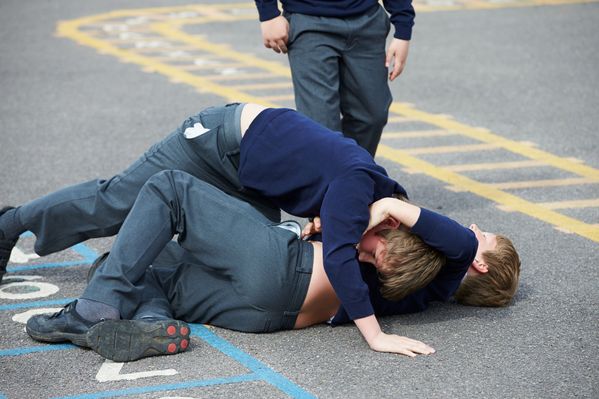
Two Boys Fighting in Playground

Fighting - Momentary Periods of Physical Restriction


All students and staff deserve access to welcoming and supportive school environments. Successful school climates involve meeting all students' academic, social, emotional, behavioral, and mental health needs and ensuring staff have the necessary tools to assist students with addressing any behaviors that could otherwise interfere with learning or school safety.
Read More
PP - Intro Image - Frustration furious mad student at school yelling

De-escalation Strategies: Utilizing Pre-correcting and Prompting
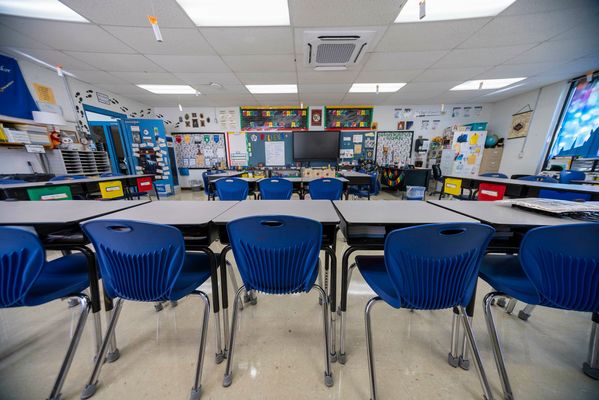

This module will examine some useful strategies and optimal conditions that adults can establish to promote student success and reduce situations of imminent danger when a student presents a serious danger to the safety and well-being of themself or others.
Read More
002 - CC - Introduction Image

Classroom Clears


This module will examine classroom clears and their use within the classroom. A classroom clear, sometimes called a room clear, means removing all other students from the classroom to de-escalate the one remaining child. Schools frequently keep no records of the frequency or duration of room clears, and staff do not realize the unintended negative consequences of their use.
Read More
001 - BOR Intro - Getty Student sitting in hallway on chair time out

Understanding Restraint and Time-Out: A Guide for Families


At times, school staff must use physical restraint or time-out (RTO) in response to significant behavior when a child presents immediate danger. These techniques are considered emergency safety interventions and should only be used during very special circumstances. This guide explains key terms, outlines student and family rights, and encourages collaboration between families and schools to support students and reduce the need for RTO.
Read More
DSO - Conclusion Image with man standing in hallway with tablet

Designated School Official (DSO)


Illinois Administrative Code 23 IAC 1.285 sets clear standards for using restraint and time-out (RTO) in schools. The Code, which can be found at 23 Ill. Admin. Code 1.285(i)(3), assigns specific responsibilities to the Designated School Official (DSO), the primary administrator overseeing these procedures, documentation, and compliance with all related requirements.
Read More
Administration or principal showing thumbs up hand gesture with teachers in background

Administrator Support of a Behavioral System

Leaders are being called upon to balance the urgent needs of students with the equally pressing responsibility of sustaining staff well-being. This module examines the critical role of school administrators in building and sustaining effective behavior support systems grounded in evidence-based practices.
Read More
RTO Complaint Image - Grievance Procedure

Know Your Rights - RTO Complaint Process


This module intends to help families understand when the RTO complaint process is appropriate, how to submit a complaint, what details to include, and what types of situations the process is designed to address.
Read More
Looking at a stack of papers with pen in hand

Understanding Documentation After RTO


This module will present information regarding the documentation process step by step and describes the forms and notifications families should expect to receive.
Read More
Paraprofessional Module

The Power of the Paraprofessional to Support Student Behavior


This module focuses on practical strategies paraprofessionals can use to support positive student behavior.
Read More